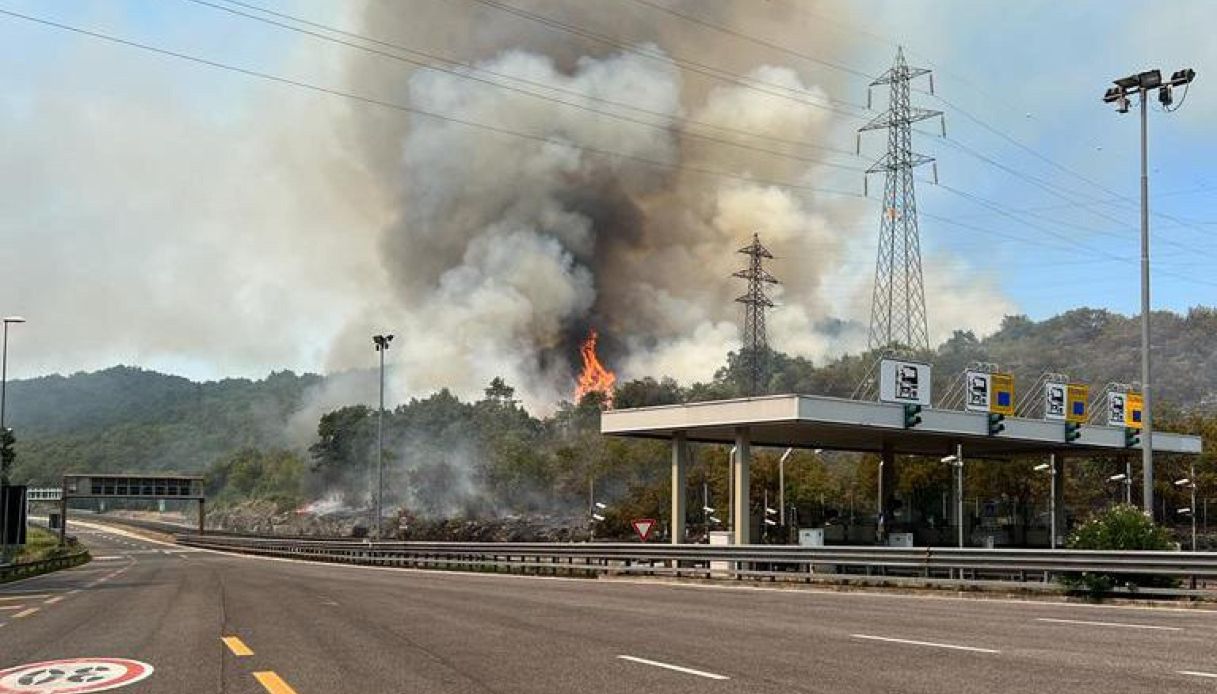
Two municipalities — one in Italy, one in Slovenia, both scarred by the 2022 fire — put real budgets and real work behind the project's recommendations. This is what cross-border adaptation looks like on the ground.
On a 9-hectare slope above the SS 55 — burned in 2022, now classed extremely vulnerable — the municipality is undoing decades of fire-prone black-pine plantation and bringing back the open Karst heathland.
Crews removed fire-killed and high-risk black pine — about 270 m³ of dead wood — using low-impact rubber-tyred tractors and no earthworks, protecting the native oak and hornbeam already regenerating underneath.
The municipality is acquiring electronic-nose (VOC / CO / CO₂) sensors and survey drones that feed straight into the Karst Firewall platform for early detection and recovery monitoring.
Targeted, subsidised pastoralism keeps woody encroachment down — a measure that reduces fuel and restores EU-protected dry-grassland habitat (6210) at the same time.
Duino Aurisina also manages the Falesie di Duino reserve, home to Centaurea kartschiana — a plant that grows nowhere else on Earth.
ZRC SAZU's analysis showed exactly why the 2022 fire ran so far: as farming was abandoned, the landscape filled with fuel. The municipality's three pilot actions target that directly.
Sheep, goats and donkeys, with fencing and a water cistern, hold open the Nova vas burn area — backed by municipal budget and the national invasive-shrub decree.
Volunteers trained in the UNESCO-listed craft are rebuilding walls — kept clear by a 10 m vegetation-free band — that slow surface fire and carry the Karst's cultural memory.
Community clearing of an overgrown sinkhole (dolina) reopens a natural low-fuel patch and a biodiversity refuge.
With ZRC SAZU, the municipality will report which measures worked, their upkeep cost, and how to fund a wider roll-out — municipal, national and EU.
The fire that took roughly 1,000 hectares also stripped the overgrowth and revealed the authentic Karst beneath — kilometres of dry-stone walls, First-World-War trenches, scattered stone. The pilots turn that hard reset into a template: manage the cultural landscape actively, and it becomes a landscape that resists fire.
Source: deliverables D2.2.1 (Duino Aurisina pilot actions, IUAV) and D2.2.2 (Miren-Kostanjevica pilot measures, ZRC SAZU & the Občina with PiNA), WP2, 2026.