Home/The project/Research & results

Where the Karst burns — and why

The project mapped, for the first time across the whole cross-border Karst, both the hazard (where wildfires are likely to start) and the vulnerability (where the land is predisposed to burn) — and tested how both shift under near-future climate. The verdict is unambiguous: human infrastructure, above all proximity to roads, is by far the strongest driver of wildfire on the Karst.

The driver

A climate that is already changing

Before mapping where the Karst burns, the project measured why the danger is rising. Combining Italian (ARPA FVG) and Slovenian (ARSO) station records with EURO-CORDEX and CHELSA climate models, it built one cross-border climate baseline for the plateau.

+1.5 °Cmean annual temperature rise over 30 years at the Sgonico/Zgonik station (278 m).
~30 → ~50hot days above 30 °C per year, from the 1990s to today.
~5 → ~15tropical nights (min above 20 °C) per year over the same period.
+1 to +6 °Cprojected warming by 2100 across the RCP 2.6 / 4.5 / 8.5 scenarios.

Rainfall totals are holding, but the distribution is shifting — drier springs and summers (about −4 mm per season), wetter autumns and winters, and longer dry spells. Hot, rain-starved summers dry out woody fuel and lengthen the fire season: the 2022 summer ran a full 1 °C above the 1991–2020 average. This is the trend the whole adaptation project is built to answer.

Source: deliverable D1.1.1 "Climate-change assessment on the Karst between Italy and Slovenia" (WP1), IUAV & ZRC-SAZU with ARPA FVG, 2025. Open access on Zenodo →

0.754
AUC of the MaxEnt hazard model (5-fold cross-validation) — statistically valid.
50.6%
of the hazard model's predictive power comes from distance to roads alone.
67.4%
of the 2,367 historical fires started within 50 m of a road.
98.6%
of past fires fall in the most-vulnerable classes — the map validates against reality.
How it was done

Two complementary models, one evidence base

The study covers roughly 1,000 km² of the limestone Karst plateau — about 30% in Italy and 70% in Slovenia — rising sharply from the Adriatic coast across a Mediterranean-to-continental climate gradient, from holm-oak scrub and downy-oak woodland to widespread planted black pine.

HAZARD

MaxEnt — where fires start

A maximum-entropy machine-learning model compares the conditions at known ignition points against the rest of the territory to estimate ignition probability everywhere. It was trained on 2,367 real fires (1990–2024), spatially thinned to 1,206 points to remove clustering bias, over ten explanatory variables at 3 m resolution.

  • Anthropic: distance to roads, railways and settlements
  • Environmental: land cover / forest type
  • Climatic: mean annual temperature & precipitation
  • Topographic: aspect, slope, TPI, TWI
VULNERABILITY

MCDA / AHP — where fire takes hold

A multi-criteria analysis asks a different question — regardless of past events, where is the land itself predisposed to burn? Each factor is scored 1–5 and combined in a weighted overlay, with weights set by Analytic-Hierarchy-Process pairwise comparisons (consistency-checked).

  • Anthropic ≈ 51% (roads 37% · settlements 9% · railways 5%)
  • Land cover ≈ 31.5%
  • Topographic ≈ 11.6%
  • Climatic ≈ 5.8%
The result

A plateau broadly predisposed to fire

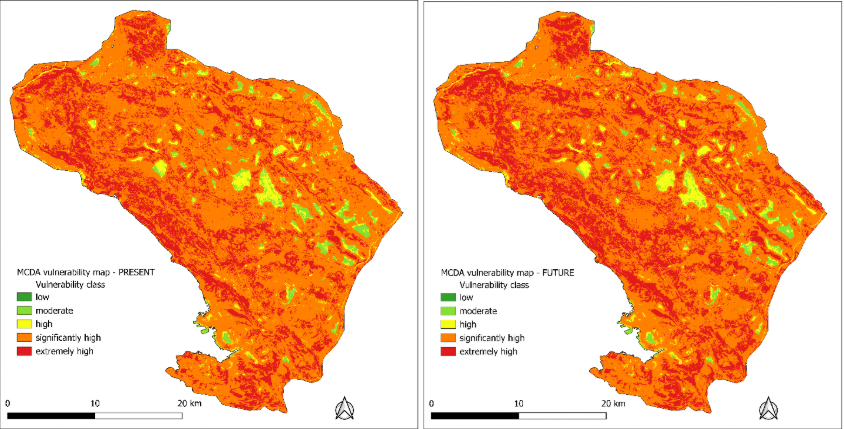
Wildfire vulnerability map of the Karst (MCDA/AHP), five classes
Figure 7 — Wildfire vulnerability map (MCDA/AHP). Five classes from low to extremely high. Almost the whole plateau falls in the two highest classes — ~68% "significantly high" and ~25% "extremely high", concentrated along roads, railways, settlement edges and on drier south/south-west slopes.
Roads dominate

Distance to roads contributed 50.6% of the hazard model — followed by land cover (16.3%) and railways (16.1%). Climate and terrain mattered little.

Fires hug the network

67.4% of fires started within 50 m of a road (mean 52.5 m); 14% within 50 m of a railway.

Hazard is concentrated

The two highest hazard classes cover only ~16% of the area, yet capture 41% of past fires in the top class alone.

Vulnerability is pervasive

~93% of the plateau rates significantly or extremely vulnerable — and 98.6% of past fires land there, validating the map.

Fuel matters

Past fires concentrated in semi-natural land (40%) and broadleaf forest (37%); fire prefers drier south/south-west slopes and ridges.

A cross-border signal

Over half of fires are of unknown cause; accidental and arson fires are proportionally more common on the Slovenian side, with peaks tracking drought years.

The climate angle

When the two models disagree, that is the finding

Re-run on near-future climate (2011–2040), the hazard model projects a slight decrease in ignition likelihood (and a shift of risk from the coast toward the interior), while the vulnerability model projects the most-exposed land growing from ~25% to ~30%. The divergence is honest, not contradictory: the climate inputs are only annual averages of temperature and rainfall, which cannot capture the seasonal hot-and-dry spells that actually drive fire weather. With rising temperatures and prolonged drought, fires are expected to become more frequent and intense — the motivation for the whole adaptation project.

A proposal

A shared data protocol for fire reporting and characterisation

Fire reports and post-fire characterisation are recorded in many formats on each side of the border, which makes them hard to pool and compare. We propose an open, shared data and attribute protocol for wildfire reporting and characterisation — a controlled set of fields and vocabularies, persistent identifiers and open formats — so records from Italy, Slovenia and beyond become FAIR: Findable, Accessible, Interoperable and Reusable.

Findable

Every fire event carries a persistent identifier and rich, searchable metadata — when, where, who recorded it and to what confidence.

Accessible

Records are served through an open API in standard formats (GeoJSON, CSV) under an open licence, with no login for the public layer.

Interoperable

Shared controlled vocabularies and units — cause, fuel model, severity — aligned with EFFIS / Copernicus EMS and INSPIRE, so both countries speak the same language.

Reusable

A documented, versioned schema with provenance and quality flags, so the same record feeds analysis, the risk index and the spread simulator.

A proposed core record links the ignition (time, location, cause), the pre- and post-fire vegetation state (NDVI and fuel class), the fire weather at ignition (the Karst FWI and its drivers), the event geometry (perimeter and burned area) and the suppression response — the same fields the index and simulator already consume, finally made comparable across the border.

In short

A robust evidence base for cross-border prevention

The two methods are complementary: MaxEnt pinpoints where fires are most likely to ignite, MCDA/AHP shows where fire is predisposed to spread. Across both, distance to roads is the single most influential factor, followed by land cover — confirming that human infrastructure is the decisive driver of wildfire on the Karst, concentrated along the coast and near settlements.

Source: deliverable D1.1.2 "Wildfire hazard and vulnerability assessment on the Karst and the impact of climate change" (WP1), IUAV University of Venice & ZRC-SAZU, 2025. Open access on Zenodo →

The evidence base

Deliverables & open data

The project's findings are published openly so anyone — researchers, administrations, first responders — can build on them.

CodeTitleWPLead / partnersAccess
D1.1.1Climate-change assessment on the Karst1IUAV, ZRC SAZU (ARPA FVG)Zenodo →
D1.1.2Wildfire hazard & vulnerability assessment1IUAV, ZRC SAZUZenodo →
D1.3.1Abaco — catalogue of risk-reduction actions1IUAV (Corpo Forestale FVG, Zavod za gozdove SLO, Infordata, ZRC SAZU)in publication
D1.4.1Participatory labs, co-production & capacity building1IUAV, ZRC SAZU, PiNAin publication
D2.2.1Pilot actions — Duino Aurisina2IUAV, Comune di Duino Aurisinain publication
D2.2.2Pilot measures — Miren-Kostanjevica2ZRC SAZU, Občina Miren-Kostanjevica (PiNA)in publication
D2.3.1Remote-sensing database2ZRC SAZU (Infordata)in publication
D2.3.2Near-real-time pilot-area maps2ZRC SAZUin publication